3D Printed standard gauge railcars

(BR built)

Non loco propelled passenger stock such as EMUs, DMUs and autotrains


 Class 501 EMU   Class 504 EMU   Class 306 EMU EPB EMU
Class 310 EMU       
Class 100 DMU Class 109 DMU Class 120 DMU Class 126 DMU
AEC/BUT railcars BR Waggon und Maschinenbau railbus    
Class 201(6S) DEMU  Class 206 (Tadpole) DEMU     
Wickham Maintenance trolleys      


Standard Gauge  
Railcars and multiple units  
   

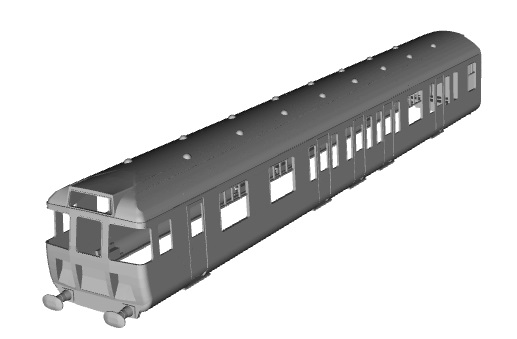
BR Class 501 EMU motor driver and driver trailer coach

The British Rail Class 501 electric multiple units were built in 1955/56 for use on the former LNWR/LMS suburban electric network of the London Midland Region.
Each train consisted of a motor driver coach, a centre coach, and a trailer driver coach. The body on both motor and trailing driver coaches is the same.
All passenger doors had bars on windows , which need to be added.
Model requires chassis

Details of models available


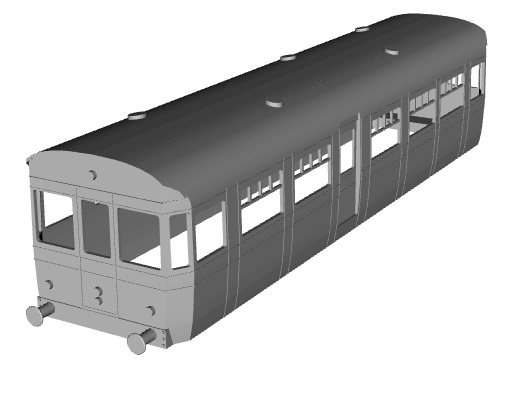
BR Class 504 EMU driver motor coach

The British Rail Class 504 was a unique type of electric multiple unit that ran on 1200 V DC third rail with side-contact current collection. The type was used only on the Bury Line between Manchester and Bury. They were built in 1959.
Operated as a 2 car train, one driver motor coach, one driver trailer. This is the driver motor coach.
requires chassis

Details of models available
   

BR Class 120 DMU 

The Class 120, were a cross-country DMU in three-car formation, built at the British Rail Swindon Works.
Totaling 194 cars, three batches were built:

1958 - 49 sets for the Western Region
1959 - 7 sets for the Scottish Region
1961 - a further 9 sets for the Western Region

Details of models available
   

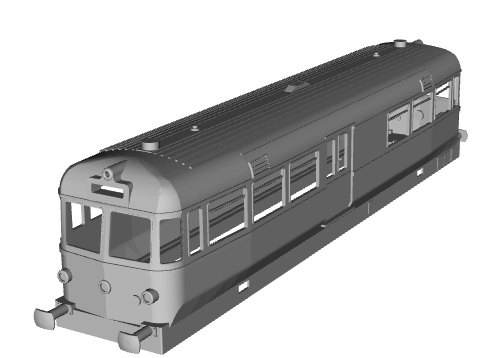
AEC/BUT railcars

Nicknamed the "flying bricks", a 3-car set was built as a demonstration train, formed of two power cars and a centre trailer, although it could also be operated as a one or two car train,

The bodies were built by Park Royal, and the underframe and mechanics by AEC. Initially they were numbered Cars 1-3, but later given the BR numbers M79740-2. They were trialed in many places around the country, leading to them being bought by the LMR in January 1955 and a further set and spare power/trailer car delivered in 1955 and another 3-car in 1957. The later eight cars (M79743-50) didn't have the bodysides skirts, and had sliding lights rather than droplights on the sides


Details of models available

BR 4 wheel railbus

Waggon und Maschinenbau

Details of models available
   

Class 109 DMU

The British Rail Class 109 was a class of 2-car diesel multiple units built in 1957 by D Wickham & Co. Five two-car units were built featuring an unusual body design. 

The units soon became non-standard and two were sold back to the manufacturer who exported them to Trinidad and Tobago. Another unit was converted into departmental service, and survived in BR ownership until the early 1980s.This has been preserved and restored to working condition at the Llangollen Railway.

Requires finishing off, wheels and mechansm etc.

Details of models available
 

Class 100 DMU (Gloucester RC&W)

Built by Gloucester Railway Carriage and Wagon Company Limited from 1956 to 1958.
2 batches with different front ends.
Withdrawals started in 1969. The last was withdrawn from service in 1988.
3 cars are preserved.


Requires finishing off, wheels etc

Details of models available
   

BR Class 126 DMU

motor brake coach - leading end type
motor brake coach - intermediate end type
motor second coach - intermediate end type
trailer buffet first coach
trailer composite coach
motor brake coach - 1959 batch

Built by BR Swindon Works in 1959/60 to work services from Glasgow to Ayrshire and comprised 22 3-car sets based on the earlier Swindon-built trainsets that had been introduced in 1955 to work the Edinburgh Waverley - Glasgow Queen St services. These vehicles formed the first Inter City service to be operated by diesel units in Great Britain
More units were introduced in 1959, with an altered leading motor brake coach. 
Withdrawn in 1980s.

Requires finishing off, wheels etc

Details of models available


Class 306 EMU

Class 306 trains were built to a pre-World War II LNER design by Metro Cammell 

When built the trains were energised at 1,500 V direct current (DC) which was collected from overhead wires by a diamond pantograph located above the cab on the Motor Brake Second Open (MBSO) vehicle.

In the early 1960s the overhead wires were re-energised at 25,000 V alternating current (AC) (and 6,250 V AC in the London area) and the trains were rebuilt to use this very different electrical system. The pantograph, now a more modern Stone Faiveley AMBR design, was moved to the roof of this carriage, which reduced the headroom inside the train, so the the guard's compartment was relocated to be directly below the 
The Class 306 trains were withdrawn in the early 1980s, and one unit, 306017, has been preserved.

Requires chassis, and finishing

Details of models available
   

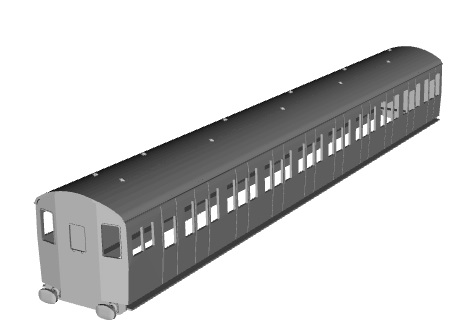
 EPB EMU and luggage vans

Standard Southern Region non corridor EMU was the EPB introduced in early 1950s.

Eastleigh build stock also  introduced in mid 1950s, to replace older NER stock on Tyneside 

lines. 

Motor luggage van moved to Southport line when Tyneside lines de-electrified in 1960s, but then scrapped in 1967.

EMU moved to London when Tyneside lines de-electrified in 1960s,modified to SR style front end, and ran until 1980s.

Requires chassis,wheels etc

Details of models available

Class 201 (6S) Hastings DEMU

The British Rail Class 201 (or 6S) six-car diesel-electric multiple units (DEMUs) were built in 1957-1958 . They were built for the London-Hastings line, with a narrow body profile to accommodate the restricted tunnel loading gauge on that line.

Requires chassis,wheels etc

Details of models available

Class 206 (Tadpole)

The class 206 3 car unit was created in mid 60s using spare motor coach , trailer 2nd, and EPB driving trailer coach . Nicknamed Tadpoles due to the different width of the Hasting stock and the EPB coach. These were used on the Tonbridge to Guildford line for many years.

Details of models available

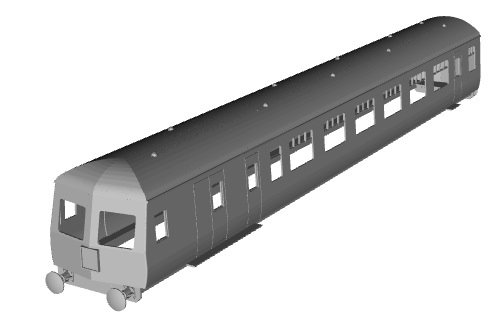
BR class 310 EMU (AM10)

Class 310 was a slam-door, AC electric multiple unit introduced in 1963 as part of the West Coast Main Line electrification project.
Initially classified as Class AM10 units before the introduction of the TOPS classification system.
They were the first EMUs to be based on the British Rail Mark 2 bodyshell.
Started to be replaced from 1987. Final examples withdrawn 2002. None have been preserved. 


Requires finishing off, wheels etc

Details of models available
  

Wickham Trolley

The Wickham trolley was a railway engineering personnel carrier, to run on standard gauge and narrow gauge(often the same ones) .


Requires chassis and finishing

Versions with and without roof, so can be modeled open, or with a lightweight roof

Details of models available

Pictures are just for reference, not of specific scaled model. 


All 3D printed designs by Simon Dawson (Rue d'Étropal) , currently produced to order by Shapeways. Just follow links to Shapeways pages.


===============================

Link to:

          3D printed standard gauge locomotives

          3D printed standard gauge rolling stock

          3D printed standard gauge railcars-ex SR

              3D printed standard gauge railcars - ex GWR

              3D printed standard gauge railcars - ex LNER

           3D printed standard gauge railcars - ex LMS

              3D printed standard gauge railcars/trams - LT


        3D printed narrow gauge locomotives

            3D printed narrow gauge rolling stock

        3D printed track and accessories

        3D printed road vehicles

        3D printed modular buildings


>>>>>>>>>>>>>>>>>>>>>> back to 3D Printing Menu


======================================

Direct links to lists for each scale below

locomotives rolling stock
     

====================================================

Currently adding links to all my designs, all other designs please go to my Shapeways e-shop.